The role of community in the design system space
I’ve learned, over the years, to trust my instincts. A few years ago I felt the nudge to find more community in the design system space. I had joined Slack groups, attended and spoken at design system events, and participated in webinars about the subject—all of which were great. However, something was still missing. My experience in these scenarios felt the same: a small number of people were teaching, and everyone else was learning.
Because of this default context, I wasn’t really connecting with other practitioners. There was a distance between us.
As I discussed this with a few friends in the industry I learned they were feeling it too. When you ask design system folks how they learned the skills to do their jobs, you almost always get the same answers. Of course, we learn from the “experts”—the people who were doing systems work first and who have more experience. But design systems practitioners are quick to point out that there is no “one way” to do this. The scope of what we are trying to accomplish is so complex that most of us can’t fully contain it in our brains all at one time. There are so many factors, so many disciplines, so many challenges, and so many ways to succeed in the work.
I don’t want to discredit any of the brilliant folks sharing content, speaking at events, releasing courses, or teaching workshops Heck, I’m one of them! All of those things are necessary. But there’s also a need for learning beyond these sources. There’s a need to broaden our perspectives on the problem space. I believe the most direct way to do this is through intentional community.
The deep dive we did as part of Episode 066 of The Question helped me articulate this in a more concise and meaningful way. We explored how practitioners actually learn design systems, and the responses made clear how much people rely on peers, mentorship, and collaboration rather than formal pathways.
Accessible learning
Laura Kalbag joined me as co-host and our initial conversations were so fun. We’re both educators at heart. Laura’s background in accessibility has deeply informed her approach to teaching. If you speak with her, you’ll hear in the conversation that the accessibility of the material she produces is just as important as the content itself. She cares so much about giving learning opportunities to as many people as possible.
We gathered a lot of information in the episode. We talked at length about how we might be able to curate some open source learning paths for people interested in design systems. We’ve even started some synthesis on a skills matrix for design system practitioners. All of this is great and I’ll continue to move these ideas forward. But the thing I walked away from the conversation with was that it’s almost impossible to come into this space on your own.
So many answers made this clear.
“How have you learned the skills needed to work as a design system practitioner?”
- “By trying, failing, and keeping on trying. Supported by the community and their willingness to share their own experience.”
- “I am continuously learning from making my own mistakes and from other people.”
- “I am fortunate to have worked alongside skilled professionals that have been generous with their time and expertise.”
When there’s no formal path into a profession, you have to be scrappy. That scrappiness creates a really nice balance of humility and confidence. The design system space is loaded with scrappy people who are so willing to share what’s worked and what hasn’t. We’re willing to support others because we recognize our own need for that support.
I’m constantly reminded that design system work can be lonely in some organizations. If you find that to be the case, you may need to look outside your org for the community you need. They are sprouting up all over the place, so look around and find one that fits your values.
My instinct was right—but I didn’t realize how universal it was. You can’t learn design systems alone because design systems work is fundamentally collaborative. The 75% of respondents who said they feel qualified to do their jobs got there by working alongside others, learning from generous practitioners, and bringing multidisciplinary perspectives together. Community is how we learn, how we grow, and how we do the work itself.
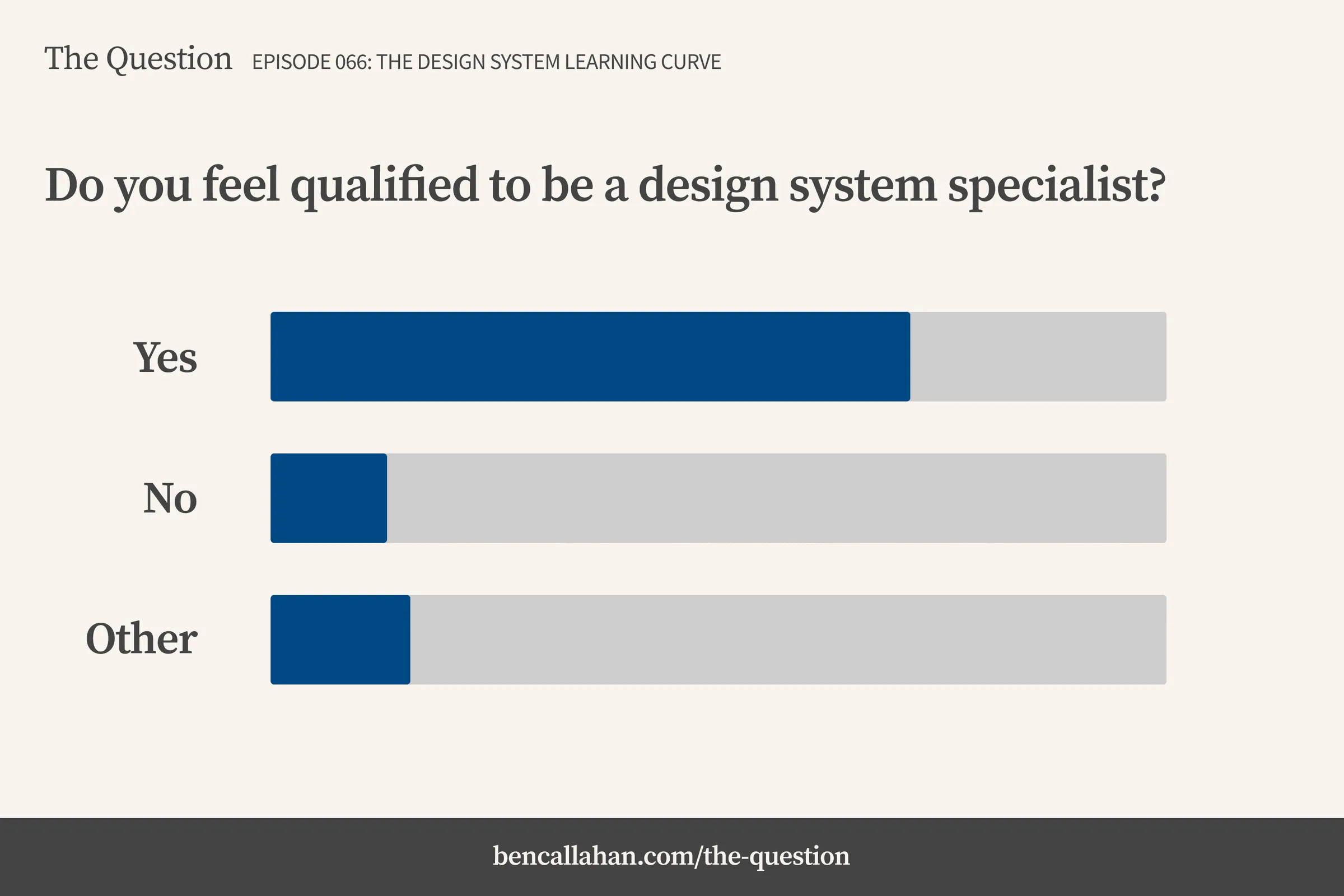 In response to the question, "Do you feel qualified to be a design system specialist?", approximately 75% of participants said, "Yes."
The most accessible form of learning out there is a strong community. I believe it’s necessary for all of us to find like-minded learners to support and challenge each other and hold each other accountable. If you don’t know where to start, drop me a note on LinkedIn and I’ll help you get connected. It may be the most important move you make in your design systems career.
On Thursday, January 15 of 2026 we held the Episode 066 design system deep dive conversation as part of a series called The Question. Thanks for being part of it.
 Ben Callahan and Laura Kalbag co-hosted Episode 066 of The Question on the design system learning curve.
Thank you
Many thanks to all who participated.
If you missed out this week, sign up for The Question and be ready to answer next time.
Resources
- Watch the Episode 066 Deep Dive
- Watch the Episode 066 Recap
- Listen to the Episode 066 Deep Dive Podcast Episode
- Listen to the Episode 066 Recap Podcast Episode
- Review the Episode 066 Raw Data
- Explore the Episode 066 FigJam
- Read the Episode 055 Recap with Lauren LoPrete on Managing your Systems Brain
- Read To Be a Leader of Systems by Hazel Weakly
- Connect with Ben on LinkedIn
- Connect with Laura on LinkedIn
- Get The Question in your Inbox
- Join Redwoods Design System Community
Writing Design Systems The Question Featured
Join Redwoods, a design system community.
Sign up for The Question, a weekly design system deep dive.
Explore more of my writing and speaking.
Or, inquire about design system coaching