What is product craft in the age of AI and design systems?
Ask a design system team how they’ll raise the quality of the products they support, and you’ll usually hear one of two options. The first is to make better components, perhaps with more opinionated defaults. The second is to tighten up the quality gates: give the DS team the authority to approve quality, not just the aspiration to improve it.
These are both good plans. But they don’t necessarily result in the end products actually getting better.
A design system can only raise the quality floor. It sets the baseline below which nothing should ship. An accessible-by-default button, a holistic and thoughtful approach to spacing, a template that starts a consuming team ten steps ahead.
But a design system alone can’t raise the quality ceiling. That’s not something you can do by delivering assets. The worst product teams can make awful experiences with the best design systems. That’s because the quality ceiling is set by the choices product teams make with what you give them. It’s their restraint, it’s where they push, and it’s knowing when to deviate from the standard because the standard isn’t serving the end user.
It comes down to this incredibly frustrating reality: everyone says they want to build things right until they have to choose between high quality and speed to market. I’ve racked my brain on this one. All of my clients are asking their design system teams to move faster. All of those teams want to slow down because “quality takes time.”
Want to know the secret to delivering higher quality work in shorter timeframes? Craft. But it’s not as simple as it sounds.
First, let’s draw a distinction between craft and quality. Craft is the skill needed to deliver continually higher quality work. We can more easily define quality—you and I could sit in a room and make a list of the things we’d measure and the threshold above which we’d consider them “high quality.” Craft is a bit more ambiguous. Craft comes down to something uniquely human: care. If you care about your work, you’ll improve your craft.
In a recent episode of The Question, we sketched it out like this.
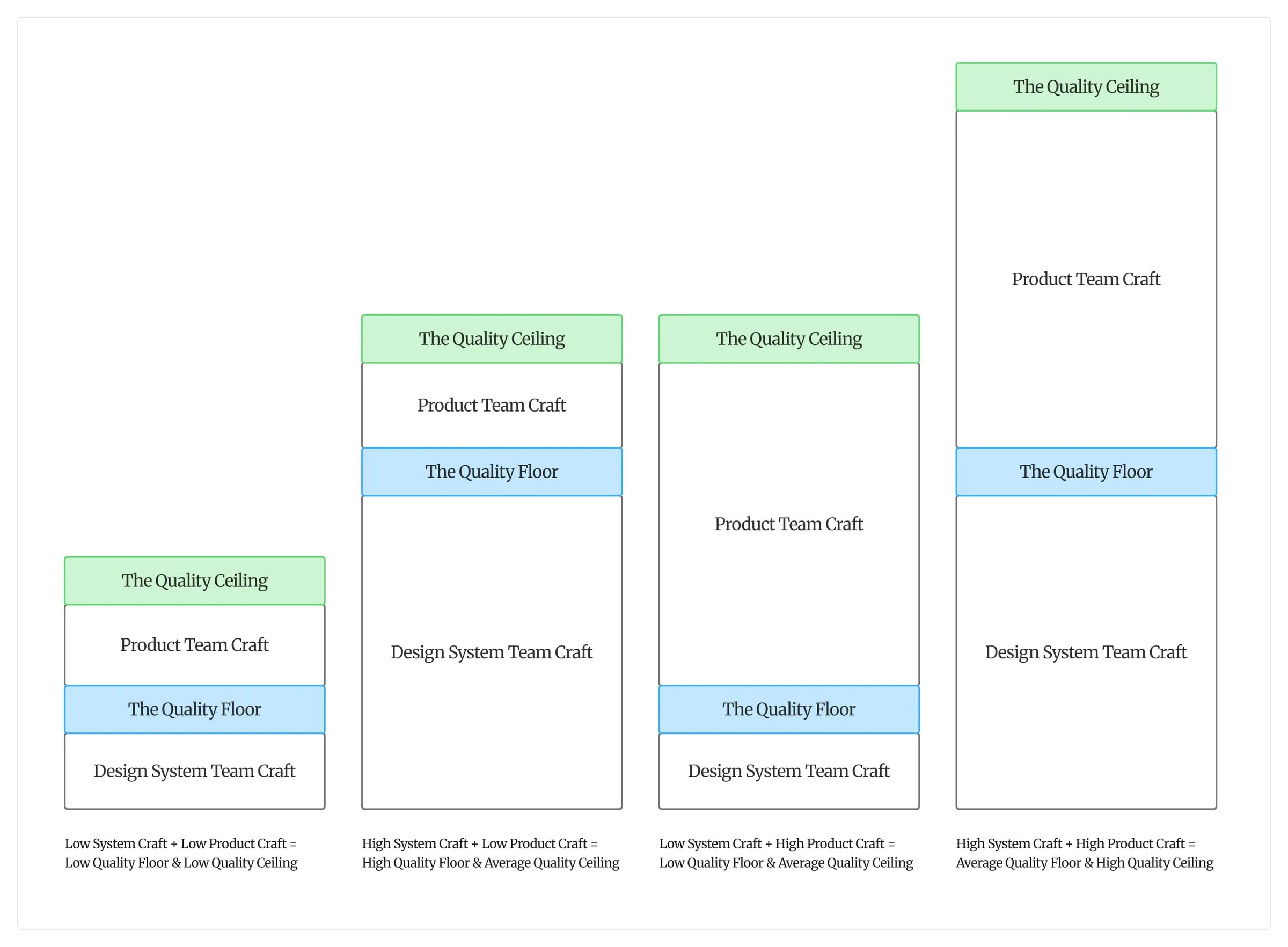 Diagram showing four scenarios illustrating how Design System Team Craft and Product Team Craft combine to determine a Quality Floor and Quality Ceiling. Scenario 1: Low System Craft plus Low Product Craft equals a low Quality Floor and low Quality Ceiling. Scenario 2: High System Craft plus Low Product Craft equals a high Quality Floor but only average Quality Ceiling. Scenario 3: Low System Craft plus High Product Craft equals a low Quality Floor and average Quality Ceiling. Scenario 4: High System Craft plus High Product Craft equals an average Quality Floor and high Quality Ceiling. Each scenario is represented as a stacked bar, with Design System Team Craft at the base, the Quality Floor as a blue band, Product Team Craft above it, and the Quality Ceiling as a green band at the top.
When you look at it this way, it’s clear that design system and product teams each need to take responsibility for their own craft, independently. But for the overall quality of your product to be high, both teams need to come to the table. Craft shows up in how each team thinks, what they notice, and what they’re willing to fight for when the deadline is right on top of them.
How do we use this?
Most system teams, once they’ve accepted that they can’t raise the quality ceiling, draw the wrong conclusion. They step back thinking, “the ceiling is the product team’s job, not ours.” You’ve probably even heard me say that system teams are here to enable, not to police. It’s a more mature posture. But I’m beginning to believe it also leaves us out of the most important conversations.
Raising the ceiling and defining it are two different jobs. It’s the product team’s job to raise the ceiling of quality, but the system team has to be part of the conversation where the ceiling gets defined. Not to constrain it, but to understand it. Co-defining what quality means allows us to build a design system that sets the right high quality floor so that product teams can stretch.
This creates a beautiful loop.
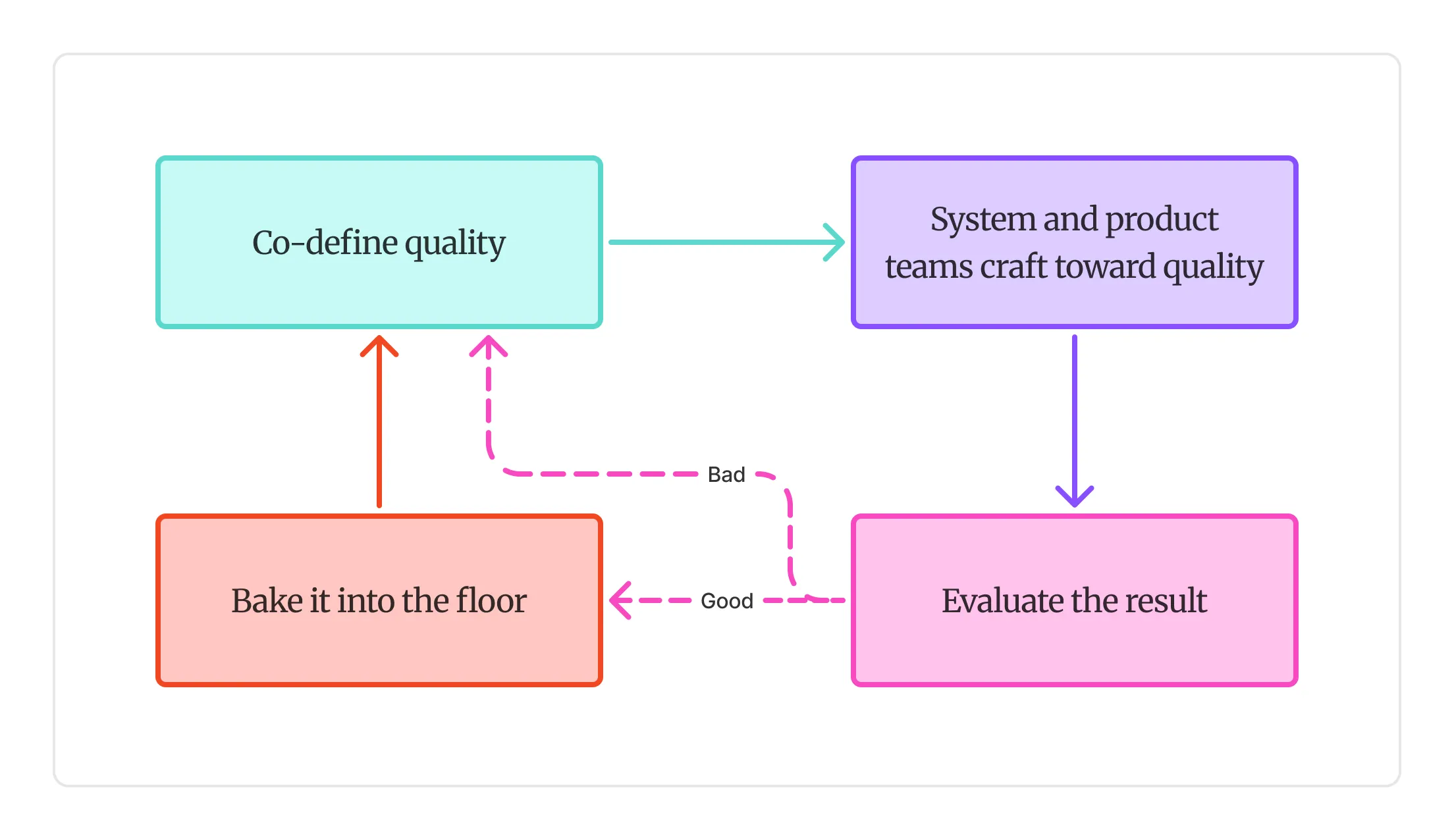 Flow diagram showing a craft quality improvement loop with four steps. Co-define quality leads to System and product teams craft toward quality, which leads to Evaluate the result. From Evaluate the result, two paths diverge: a Good path (dashed pink arrow) leads to Bake it into the floor, which feeds back up to Co-define quality; a Bad path (dashed pink arrow) skips the floor step and feeds directly back to Co-define quality.
By co-defining what quality is for our context, both system and product teams can shape their work to hit that target. This gives us the most likelihood of identifying things to bake back into the system, raising the quality floor, which allows product teams to raise the quality ceiling. Repeat. (I told you it was beautiful!)
And, of course, this loop just continues to run. Over time, the quality floor and the quality ceiling are raised.
The most important step here isn’t the shipping of a new component. It’s the time in conversation that results in alignment on a definition of quality.
Your system sets the floor. The way your system is used sets the ceiling. If you’ve poured everything into the first and bowed out of the second, it’s time to step back into ring.
On Thursday, June 18, 2026 we held the Episode 076 design system deep dive conversation as part of a series called The Question. Thanks to ToniAnn Drenckhahn for co-hosting. These ideas are formed on the shoulders of The Question and Redwoods design system communities. Watch the recap of Episode 076.
Writing Design Systems The Question Featured
Join Redwoods, a design system community.
Sign up for The Question, a weekly design system deep dive.
Explore more of my writing and speaking.
Or, inquire about design system coaching