Evolving Design System Skills
Any artist will tell you that the tools they use impact their art. The same is true for us—the tools we use in our design systems work certainly impact the approaches we take. Given that we are not only using tools, we are building them for our consumers, it felt like this was a concept worth exploring. That’s the topic Natalya Shelburne and I asked the design system community for Episode 061 of The Question.
On September 25, 2025, Natalya and I facilitated a deep dive discussion into the data we gathered from 46 design system practitioners. We asked the following three questions:
- What’s one new skill you’ve had to learn because of a change in tooling?
- What’s one new skill you expect your consumers to learn in order to use your design system well?
- What’s one skill you hope not to need in the future because of the disruption of AI?
Reading through the raw data, it’s clear that we are all feeling the pressure of constant learning. The tools, technologies, and ways of working are changing around us at a pace we’ve never experience before. One respondent summed it up nicely:
“In general, I do feel like the amount of things to learn gets bigger by the day and the hours in a day remain the same.”
Perhaps you’re feeling this too, as so many of the participants in this week’s discussion were.
What to look for in design system practitioners
To start the conversation, I invited Natalya to share what she really wanted to hear from the participants. She took us in a direction I wasn’t expecting, asking everyone to share their thoughts on the core skills that are necessary for folks working on a DS team.
For her, the key skill was discernment. From her view, leading the DRUIDS design system at Datadog, the ability to know what areas of learning to lean into is critical. I tend to agree with this sentiment and the way I’ve found to help here is to surround myself with other like-minded learners. Community surfaces the most crucial ideas. In many ways, The Question community does this for me each time we do a deep dive. You all constantly challenge my perspectives and I hope you leave our conversations feeling the same.
Jasha shared that making decisions in the midst of change was a skill she felt critical in design systems work. Similarly, Kacey suggested troubleshooting as a necessary core skill, and Steve said critical thinking. About this time, Guy chimed in to state the pattern that was emerging: “the core skills of a human being will always remain.” His example reminded me of the big takeaway from Episode 060 with Nathan Curtis:
“We think of AI prompting as a new skill, but in reality, it’s the same skill we need to figure out how to do the work ourselves.” (Guy)
This is so true. Good prompting requires you to clearly articulate what you want. Someone who struggles with that will likely struggle in a lot of areas other than using an LLM.
Empathy
Davy offered another critical skill that he shared has been extremely valuable in his career: empathy. From his perspective, empathy allows designers to move toward code and developers to move toward design. This resonated with many participants—it seems the more we work on systems the more we see the value in truly understanding the implications of the decisions we make across a range of disciplines.
From my experience as a founder of Sparkbox and a design system consultant, it’s concerning how uncommon this characteristic (empathy) is in the organizations I’ve supported over the years. I often find myself wondering how to help individuals discover the power of putting themselves in another’s position. As we were discussing how to create opportunities for this kind of growth, Jesse (a designer) shared an odd phenomenon: for him, debugging AI output has increased his empathy for engineers and the complexity of the work they do…
Hold on. You’re saying that using AI tools is increasing your desire to understand the other humans on your team?
I wondered if this was an isolated experience. But others shared something similar.
“Rapid prototyping with AI is leading ot more conversation between designers, engineers, and PMs.” (Guy)
Maybe the faster, cheaper prototypes aren’t something to be afraid of if the end result is us talking to each other more?
Regardless, we truly need more people to have that same perspective-shaping experience—something that pushes them outside their current mindset to consider the ripples of their own decisions.
Considering all of this together, I can see that individuals focused on design system work seem to be doing this. The work requires us to grow in our understanding of a breadth of disciplines. Perhaps that expanding expertise allows other (non-design system) peers, to lean deeper into their specialization. The boundaries between our roles are now, and will continue to be, very blurry.
Shiny demos and the next generation
Each time AI comes up in The Question, someone tells their own version of a story that goes something like this:
My boss’s boss’s boss saw this amazing demo of a new AI tool that [insert something amazing]. They forwarded the link to me and told us to make a plan to implement this into the design system.
Here’s Donnie’s version from this week:
“C-suite saw a prototype and wanted it shipped.”
I’m guessing, if you’re reading this, you’ve had a similar experience. I can understand why leaders do this—with a lot of swirling pressures, a cool demo can feel like a relief valve. But dropping a link to an IC with the expectation that it changes a roadmap or strategic plan is short-sighted and damaging for a lot of reasons. We need leaders who lean in more, not leaders looking for quick relief.
Cam articulated this with a reminder that, “so-called ‘low-value’ work is how juniors become seniors.” Leaders that look for this kind of quick win without real understanding are setting us up for missed expectations and damaging career ladders in the process.
Natalya dropped an idea in our chat during the deep dive:
“Hot take: we are all now teachers.”
As our education system struggles to figure out what to teach kids, we’re still left with the opportunity to train the employees we need. I agree with Natalya’s hot take—it’s our responsibility to create environments that raise the next generation rather than ones that exclude them.
Cam shared another thought—that more than half the work we do in systems work is “soft skills,” and Guy countered with “100% of our success is dependent on those skills.” The thing is, it’s hard to teach that stuff in school.
It always comes back to culture
This is why culture is SO important in design system work. We have to establish strong, aligned cultures that allow both highly skilled and experienced team members to get stuff done and model the softer skills for recent entrants into the workforce.
This deep dive reminded me of the apprenticeship program we used to run at Sparkbox. It was such a natural extension of what we believed. And so many lives were impacted by that work, including those of the folks on our team who were teaching and mentoring. Maybe a return to this kind of thinking is the perfect way to balance the rise of the robots. Taking time to work with each other in areas where we need to grow, having actual conversations, time together…
Formulas for now
I have this book called Formulas for Now by Hans Ulrich Obrist. It’s a quirky little thing, published back in 2008, with “formulas for the 21st century” contributed by artists, architects, mathematicians, and scientists. You never know what you’re going to get when you open it, which is why I love it.
This week, I turned to this page by Tim Etchells:
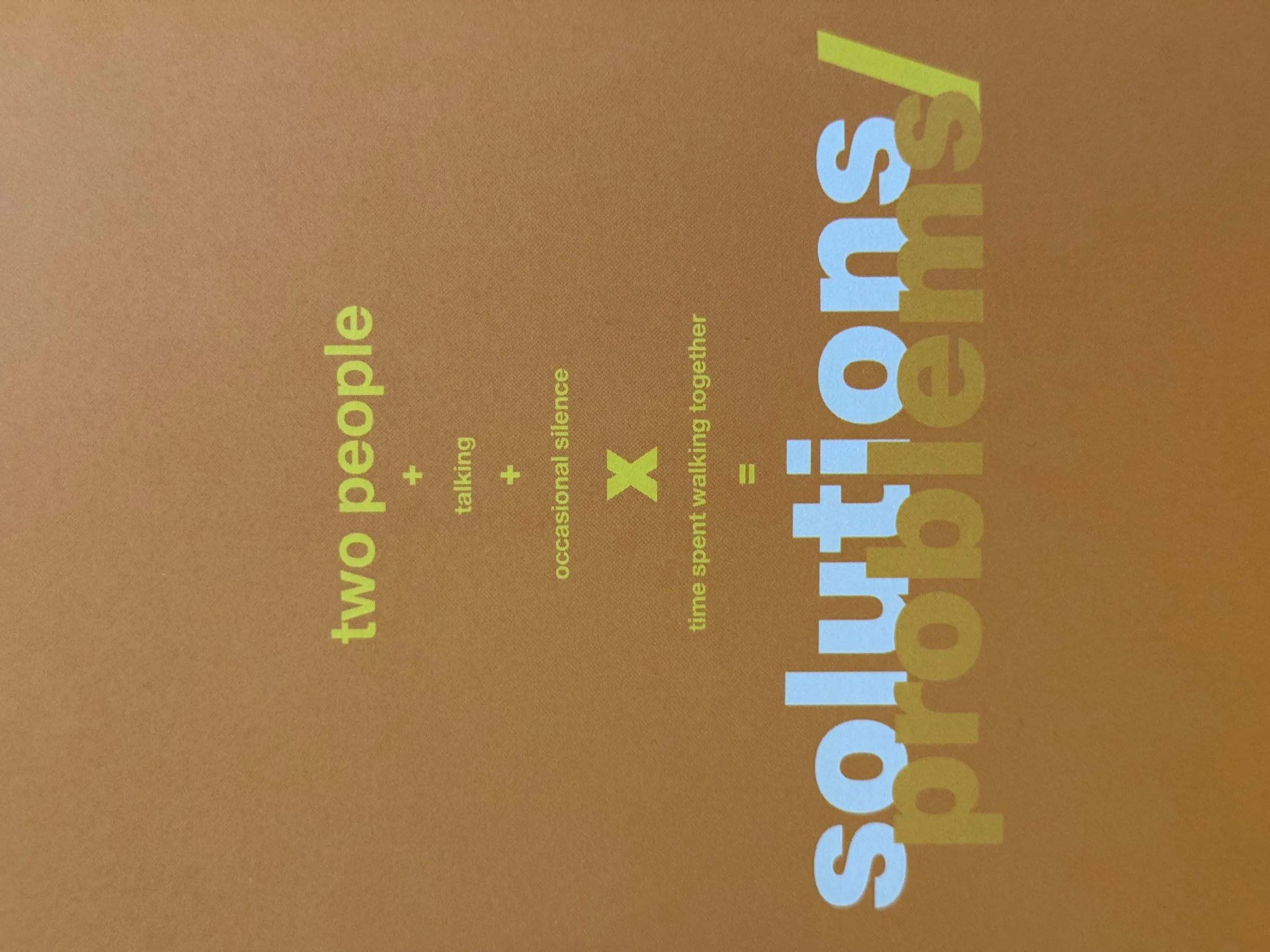 A formula for now which states: two people + talking + occasional silence X time spent walking together = solutions/problems
I read it (probably 7 times) and then thought out loud, “It’s really that simple, isn’t it.”
After this deep dive, that’s my reminder to you.
Put your phone down.
Talk to someone.
Be ok with the silence.
Get outside and breathe in the sunlight.
As a community of design system practitioners, there is a lot being asked of us. The way we solve the problems of our time is through connection, empathy, and curiosity. The tools will constantly change, but you can have all three of these values for the people on your team and in your organization. The results just might surprise you!
Find your community
Curious how others are doing this? Come hang with us in Redwoods. It’s a space for people who want to support each other on the journey of building better design system programs.
Learning mode
I am continually inspired by the people who participate week after week to dive into the answers we gather. Each one of you shows up in learning mode. Because of that, we all walk away with broadened perspectives and an appreciation for the experiences we each bring to these conversations.
To those of you who attended, thanks for joining with such a gracious posture.
Resources
- Review the Episode 061 Raw Data
- Review the Episode 061 FigJam
- Watch the Episode 061 Recap
- Connect with Natalya or Ben on LinkedIn
- Check out previous episodes of The Question
Thank you
Many thanks to all who participated.
If you missed out this week, sign up for The Question and be ready to answer next time.
Writing Design Systems The Question Featured
Join Redwoods, a design system community.
Sign up for The Question, a weekly design system deep dive.
Explore more of my writing and speaking.
Or, inquire about design system coaching